
PHYSIOTHERAPY-BASED BODY CARE
Low Back Pain Care in Bangkok
Personalized care for your lower back, hips and lower body.
Understand the factors that may contribute to discomfort, and explore hands-on care and practical movement guidance tailored to you.
90 minutes · Promotion THB 2,800
Regular THB 3,500. Please confirm the current offer when booking.
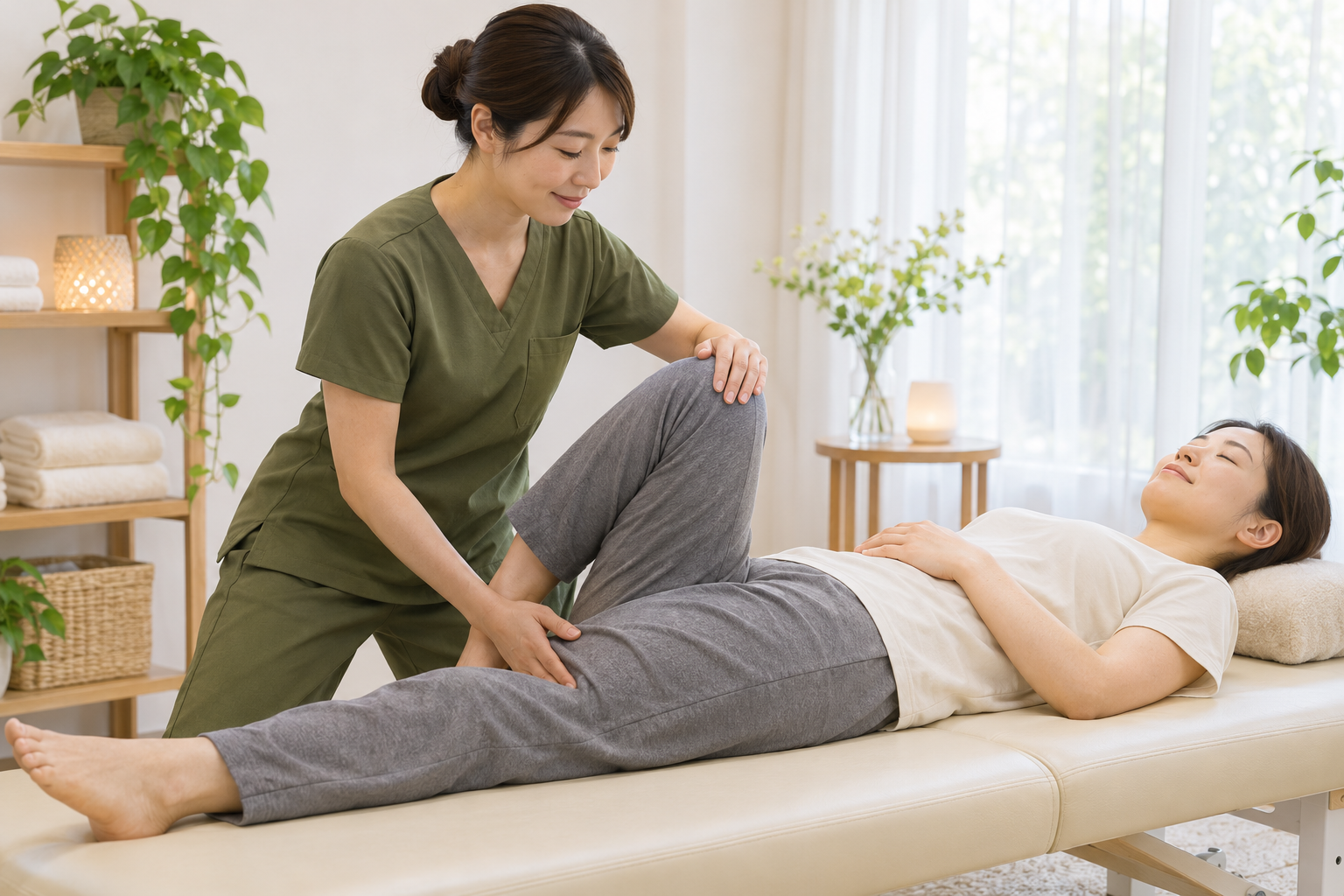
Does This Sound Familiar?
- Your lower back feels sore when you wake up.
- Sitting for a long time becomes uncomfortable.
- Massage helps briefly, but the discomfort returns.
- You have had lower back discomfort for some time.
- A hospital check found no clear abnormality, but your back still hurts.
Your experience deserves attention. Several factors may be involved, and a scan or the location of discomfort does not always explain the whole picture.
RENE’s Low Back Care Course
Your session begins with a conversation and a review of posture, movement and muscle function. Our licensed physical therapists consider possible contributing factors and select care that suits your condition, goals and comfort.
Lower back discomfort can involve several interacting factors. A single session cannot promise a lasting change; care and practical movement guidance are adapted as your needs change.
What Your Session May Include
- Consultation and movement review: Discuss your symptoms, relevant history, daily activities and what you would like to do more comfortably.
- Manual bodywork and myofascial techniques: Hands-on work focused on tight muscles and surrounding soft tissues.
- Deep Tissue Massage: Gradual work from superficial tissues towards deeper muscle layers, with pressure adjusted to comfort.
- Ultrasound: A physical modality that may be selected after discussing suitability and precautions.
- Far-infrared warmth: A warming pad may be used where appropriate.
- Stretching and exercise guidance: Practical movements and home exercises selected for your needs.
A session may combine manual care, suitable physical modalities and exercise guidance. Not every technique is used at every visit.
Understanding What May Contribute to Low Back Pain
The painful area is not necessarily the only area to consider. Posture and pelvic movement, core muscle function, hip mobility and daily movement habits can interact. The sections below explain these factors in more detail. These are possible contributors, rather than a diagnosis of your individual symptoms.
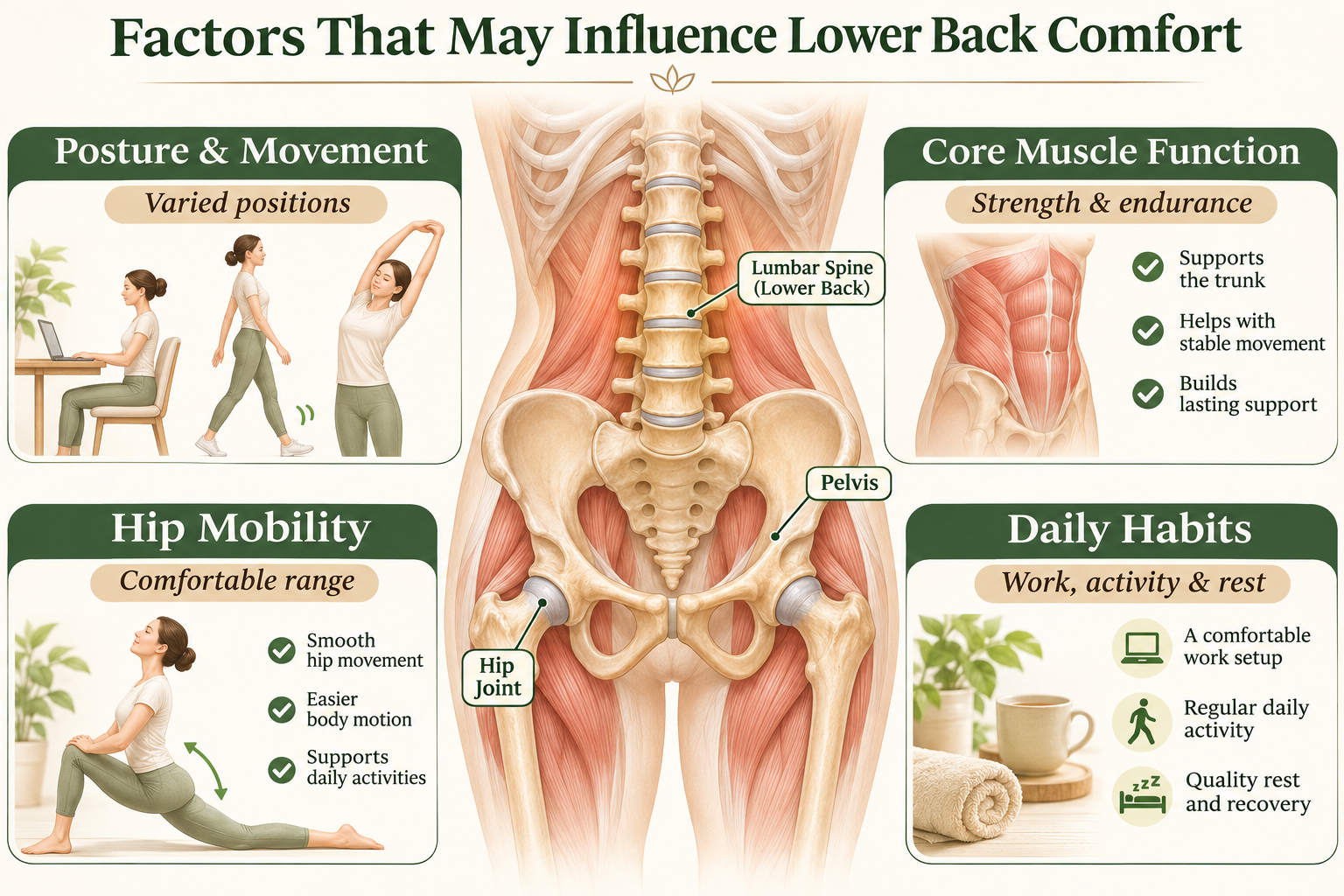
01 · Rounded Posture & a More Arched Lower Back
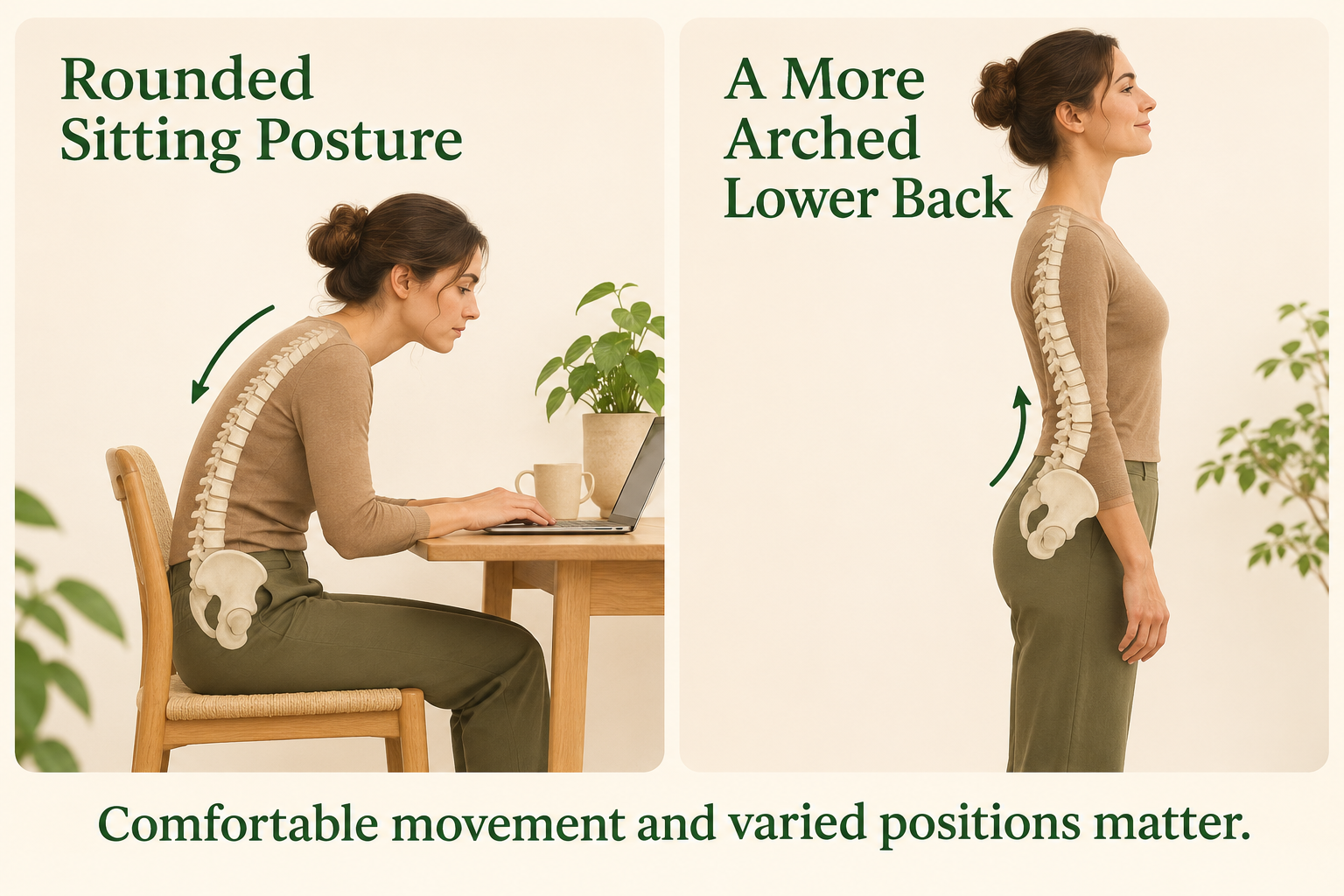
The spine normally has gentle curves. These help distribute loads as we stand, walk, sit and move. Long periods at a desk or looking at a phone may be accompanied by a rounded upper back or a more arched lower back. Posture alone cannot explain every case of pain.
Rounded Sitting Posture
When the head moves forward and the upper back rounds, the thoracic spine may move less freely. The lower back may then move more to complete a bend or turn. This can change the demands placed on the spinal extensors, quadratus lumborum and multifidus.
A More Arched Lower Back
With a forward-tilted pelvis and a larger lower back curve, the way load is shared through the lumbar joints, discs and muscles may change. Abdominal and gluteal strength and endurance may also influence how comfortably the body is supported.
Why We Consider More Than the Sore Area
Upper-back movement, pelvic position, hip stiffness and muscle function may interact. Hands-on care to the lower back may feel helpful, while ongoing movement and daily habits can also matter. We support comfort and function without promising a particular change in spinal shape.
02 · Pelvic Mobility, Not Simply “Misalignment”
A pelvis described as “misaligned” is not, by itself, an explanation for pain. In physiotherapy-based care, we also consider how the pelvis moves during walking, standing, squatting and turning.
When comfortable pelvic movement is limited, the lower back may take on more of the movement. Muscles and joints around the waist may then work harder.
What Can Affect Pelvic Movement?
- Long periods of desk work or staying in the same position.
- Limited physical activity.
- Stiff hips or reduced flexibility around the pelvis.
- Reduced strength or endurance in the gluteal and core muscles.
These factors can make everyday movement feel less fluid. We consider how the hips, pelvis and lower back move together when planning your session.
03 · Hip Stiffness
The hips contribute substantially to walking, squatting, climbing stairs and standing up. When hip movement is limited, the lower back may compensate, changing demands on muscles and joints.
Why Hips May Feel Stiff
- Long periods of sitting and desk work.
- Limited exercise or movement variety.
- A habit of crossing the legs.
- Reduced flexibility in the buttocks or thighs.
- Changes in range of movement with age.
Sitting keeps the hips bent for long periods. The iliopsoas at the front of the hip and the thigh muscles may feel tight or stiff afterwards.
When the Lower Back Takes on More Movement
Bending forward, picking an object up, putting on socks and squatting usually involve hip movement. If the hips do not move comfortably, more bending may occur at the waist. Repeatedly sharing movement in this way can affect the lumbar joints, discs, muscles and ligaments, and may contribute to persistent or sudden back discomfort.
04 · Reduced Core Muscle Function
The core includes the transversus abdominis, multifidus, pelvic floor muscles and diaphragm. These muscles help coordinate support for the spine and pelvis during everyday activity, sometimes described as a “natural corset”.
If their strength, endurance or coordination is reduced, other back muscles may work harder to support movement.
Why Core Capacity May Decline
- A desk-based routine and prolonged sitting.
- Limited exercise or movement variety.
- Spending long periods in positions that feel uncomfortable.
- Doing less activity because of back pain.
Avoiding movement because of pain may lead to a cycle of reduced activity and declining capacity. The spinal extensors may then become more tired or tense during prolonged standing, sitting, lifting or other daily tasks. Exercise guidance is gradual and based on what feels manageable.
05 · Muscle Stiffness from Desk Work
Long computer sessions can mean very little movement in the lower back, buttocks and hips. Remaining still may affect circulation and contribute to muscle fatigue and stiffness. This is sometimes described as a cycle involving reduced blood flow, oxygen supply and the clearance of exercise-related by-products; these mechanisms do not establish the cause of an individual person’s pain.
Long Periods of Sitting
Rounded sitting, leaning forward, crossing the legs or peering towards a screen may become uncomfortable when maintained. Load varies with the position and task; sitting is not inherently harmful. The gluteus maximus, gluteus medius and iliopsoas may feel stiff when you stand up or start walking.
The Hips, Pelvis, Spine and Core Work Together
When movement becomes limited in one area, the lower back may take on more of the task. Over time, this can be accompanied by tired back muscles, joint stiffness or persistent discomfort. We consider movement breaks and comfortable position changes as well as hands-on care.
06 · Lack of Physical Activity
Walking, using stairs and squatting regularly move the muscles and joints and help maintain everyday physical capacity. When these activities become less frequent, strength, flexibility and movement confidence may decline.
Changes Associated with Inactivity
- Reduced muscle strength and endurance.
- Muscle stiffness and less comfortable hip or spinal movement.
- Changes in circulation with less regular movement.
- Reduced core support during activity.
The hips, pelvis, spine, core and lower body muscles normally share the work of supporting the body. Reduced capacity in several areas can make ordinary activity feel more demanding. A tired lower back, discomfort after standing, a heavy feeling while walking or soreness with small movements may occur. An individual plan can include gentle, progressive activity.
07 · Stress & the Autonomic Nervous System
Back discomfort is not only about bones and muscles. Work pressure, relationship stress, inadequate sleep and fatigue can influence pain and muscle tension. Some people notice that their back, neck or shoulders stay tense during demanding periods.
What Is the Autonomic Nervous System?
This system helps regulate functions that happen without conscious effort, including heart rate, blood pressure, breathing, digestion, circulation and body temperature. Its sympathetic branch supports activity and alertness; its parasympathetic branch supports rest and recovery.
When Stress Persists
Persistent stress may be accompanied by muscle guarding and changes in circulation, contributing to fatigue or a stiff feeling. Prolonged alertness may be accompanied by muscle tension, reduced circulation and difficulty recovering. Stress may be one contributing factor, and is not a diagnosis made during a spa session.
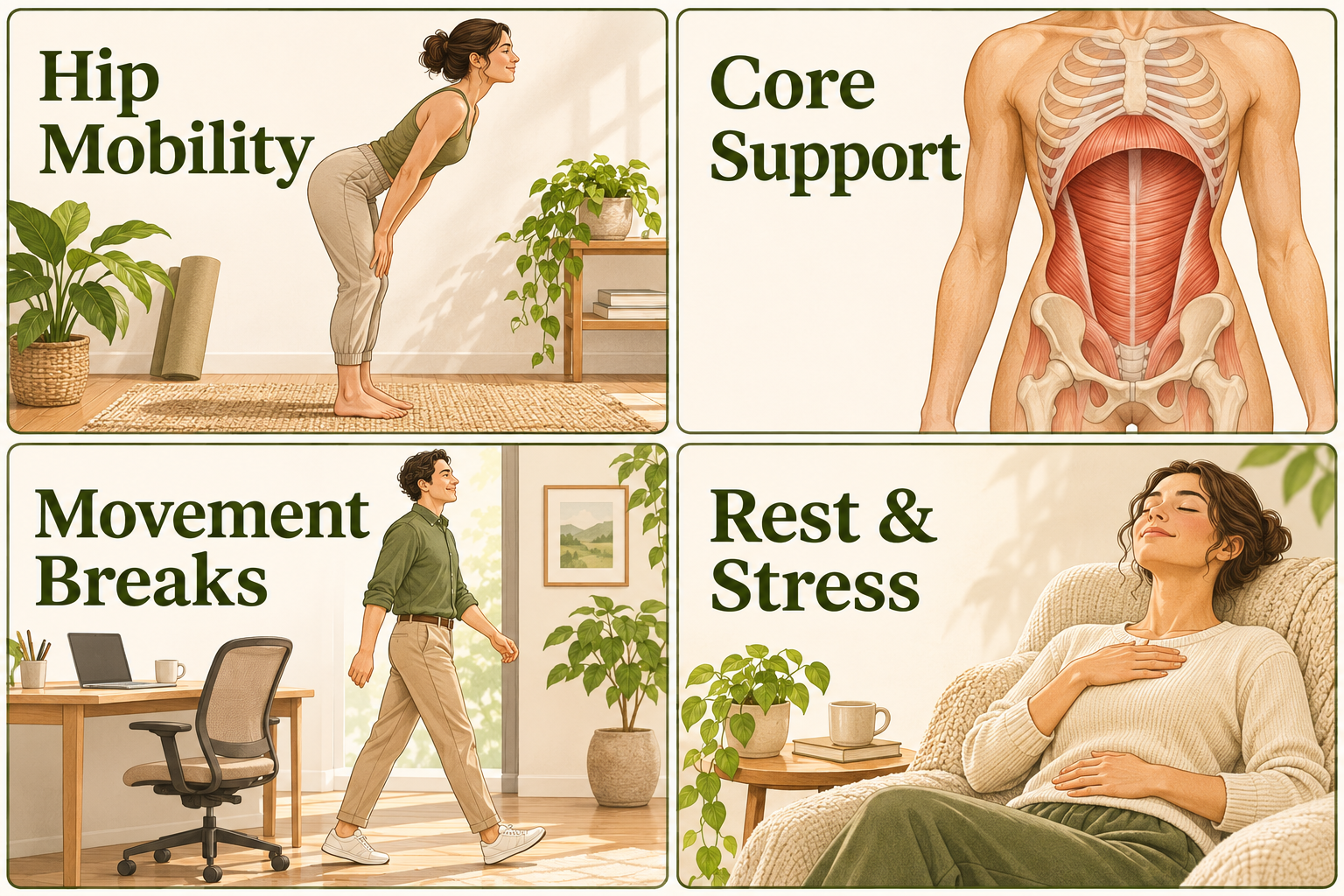
Why We Look Beyond the Lower Back
Upper-Back Movement
The thoracic spine helps with twisting and extending. When the upper back feels stiff, the lumbar region may move differently to complete the task. This can affect how effort is shared.
Pelvis & Hips
Pelvic and hip movement matters for walking, squatting and standing up. When it is limited, the lower back may compensate repeatedly.
Knees, Ankles & Weight-Bearing
- A stiff ankle may make squatting more difficult.
- Knee pain can change the way you walk.
- Consistently placing more weight on one leg can change movement patterns.
These changes may influence the back even though the original concern is elsewhere. The lower back may be responding to additional demands rather than being the only area needing attention. This is why care considers the whole movement chain.
Thoracic spine → Pelvis → Hips → Knees → Ankles
Muscles We Consider
The following muscles contribute to movement and support around the lower back and lower body. Their role varies with the activity, and a sore area does not identify a specific muscle problem on its own.
- Quadratus lumborum: Supports side bending and trunk control.
- Spinal extensors: Help support and extend the spine.
- Iliopsoas: Contributes to hip flexion.
- Gluteus maximus: Helps extend the hip during standing and other activities.
- Gluteus medius: Helps control the pelvis during walking and single-leg support.
- Hamstrings: Contribute to hip and knee movement.
- Abdominal muscles: Help coordinate trunk support.
- Multifidus: Contributes to control around the spine.
When Back Discomfort Continues
Persistent back discomfort may coexist with sciatica or other leg symptoms, hip or knee pain, neck and shoulder tension, disturbed sleep and ongoing fatigue. Pain may also discourage activity and influence posture. These difficulties do not inevitably develop because back pain is left untreated.
If symptoms persist, change or interfere with daily life, seek appropriate medical advice. Spa care does not replace diagnosis or treatment for an underlying condition.
RENE’s Physiotherapy-Based Approach
Our licensed physical therapists look beyond the lower back. We consider thoracic movement, pelvic mobility, hip flexibility, knee and ankle movement, walking and posture. The aim is to support comfortable whole-body movement and help you manage everyday strain.
Care is selected for the individual. Our team combines professional training with practical experience, rather than giving everyone the same routine. Results vary and cannot be guaranteed.
01 · Movement Review
We discuss your history and goals, then review posture, everyday movements, strength and flexibility within a comfortable range. This guides the session and does not replace a medical diagnosis.
02 · Your Individual Plan
Stretching, strengthening and mobility guidance are chosen according to what you need and what you can do comfortably.
03 · Personalized Care
Hands-on techniques, suitable physical modalities and exercise guidance may be combined. Pressure and pace are adjusted to your comfort.
04 · Ongoing Self-Care
The physical therapist and health coach offer movement, posture and lifestyle guidance between visits. No plan can guarantee that pain will not recur.
What Happens During a Visit?
- 1. Consultation: Talk about your symptoms, daily life and goals.
- 2. Posture and movement review: Check comfortable movement, strength and flexibility.
- 3. Explanation: Discuss findings and factors that may be relevant.
- 4. Personalized care: Agree on the areas, techniques, pressure and pace.
- 5. Exercise guidance: Learn practical exercises and home-care ideas.
We explain the plan before beginning and encourage you to tell us if anything feels uncomfortable.
Exercise Guidance & Health Coaching

Exercise Guidance
After the session, a female Thai physical therapist provides exercises for self-care. English and Thai are supported. Japanese interpretation can be arranged for clients who need help understanding the guidance; please confirm availability when booking.

Health & Lifestyle Guidance
RENE’s Japanese manager, a health coach, offers practical guidance on daily habits and general health. This complements the therapist’s movement guidance and supports ongoing self-care.
Original Before & After Case Examples
These are individual cases reported by RENE. Photos show observations at particular visits; they do not establish a diagnosis, demonstrate structural correction or predict another person’s outcome. Results vary.
Case 1 · Scoliosis-Related Concerns

This client had scoliosis and persistent lower back discomfort. Care addressed tight muscles around the spine together with the shoulders and neck. The case report describes a visible postural change and relief of back discomfort after one visit.
Scoliosis cannot be assumed to have been corrected by these changes. The client was given home exercises and continued approximately monthly care; the report describes little ongoing back discomfort at the time of follow-up.
This is an individual account, not a promise of pain relief or a change in spinal structure.
Case 2 · A More Arched Lower Back

This client had an arched standing posture and chronic lower back discomfort. The case report describes a change in standing balance and less discomfort after one session.
The client was given exercises for home practice and returned for posture checks roughly every three months. At the time of the report, the client described maintaining the change and no further back discomfort.
This example illustrates one person’s experience. It does not guarantee a similar result or permanent prevention of symptoms.
Choosing Your Course
Upper Body Care
For concerns involving the neck, shoulders, upper back and lower back. This may be relevant when upper-back or shoulder movement is part of your lower back concern.
Lower Body Care
For concerns involving the lower back, buttocks, hips, groin, legs, knees and feet. This may be relevant when hip movement or other lower body concerns affect comfortable activity.
Session Length & Price
90 minutes · Promotion THB 2,800
Regular price: THB 3,500. The same duration and listed promotion apply to both upper and lower body courses. Confirm the current offer when booking.
Our team includes two licensed physical therapists. Your therapist reviews movement and selects suitable manual care, physical modalities and exercise guidance. The exact combination varies with your needs.
The Techniques Explained
Manual Bodywork Informed by Physiotherapy
This hands-on approach is provided by therapists with physiotherapy education and a Thai national professional licence. Techniques focus on soft tissues, muscle function and comfortable movement.
Our service information also discusses office-related neck and shoulder discomfort, eye fatigue, headaches, joint or tendon concerns and frozen shoulder. Conditions such as arthritis or persistent headaches require appropriate clinical assessment; a spa session does not diagnose or medically treat them. Depending on suitability, ultrasound or electrical stimulation may accompany manual care.
Deep Tissue Massage
Deep Tissue Massage combines techniques that work progressively through superficial and deeper soft-tissue layers. Rather than using only light strokes at the surface, the therapist adjusts the approach to the tissues involved, your comfort and your response. Deep pressure is not required for everyone.
Ultrasound & Electrical Stimulation
Ultrasound uses sound waves above the range of human hearing; therapeutic equipment uses high-frequency sound to act on tissues. Electrical stimulation applies controlled current through electrodes. Both are physical modalities listed in RENE’s low back course information.
Our Japanese guide discusses their use in rehabilitation and mentions sports injury examples involving David Beckham and Hideki Matsui. Those examples do not establish that the same equipment, settings or outcomes apply to this spa service.
The guide also discusses tissue recovery, inflammation and muscle, joint, tendon or nerve-related pain. Suitability and evidence depend on the condition and technique. Ask your therapist about precautions and expected benefits; we do not promise tissue repair or symptom relief.
Far-Infrared Warmth
A far-infrared warming pad may provide warmth to a suitable area. Tell your therapist about altered sensation, skin concerns or any reason heat may not be suitable.
Stretching & Exercise Guidance
Gentle stretching, strengthening and mobility exercises are selected for your movement needs. The therapist explains how to practise at home within a comfortable range.
Understanding Different Symptom Patterns
Symptoms can overlap, and this information cannot tell you which condition you have. A healthcare professional may need to examine you. Do not use these descriptions as a self-diagnosis or perform provocative tests on yourself.
Acute Low Back Pain (“Gikkuri-goshi”)
- Sudden sharp pain, sometimes without warning.
- Symptoms following strenuous exercise or lifting a heavy object.
- Certain comfortable positions or rest may ease the pain.
- A similar episode may have happened before.
Disc Herniation
- Pain may be more noticeable when bending forward.
- Strenuous activity or lifting may bring on symptoms.
- A clinical straight-leg raise may reproduce symptoms; do not use this as a self-test.
- There may be numbness or other nerve-related symptoms in the buttock or leg.
Muscle & Myofascial Pain
- Symptoms may follow demanding sport.
- Bending forward or backward may not produce a clear difference.
- The muscles around the waist may feel tired, heavy or persistently sore.
Lumbar Spinal Stenosis
- Arching backward may worsen symptoms.
- Symptoms may develop with age.
- Walking may be limited by pain that improves with rest.
- There may be buttock or leg numbness or other nerve symptoms.
Spondylolysis / Spondylolisthesis
- Pain may worsen with backward bending.
- Demanding sport or staying in one position may be associated with discomfort.
- Buttock or leg numbness or other nerve symptoms may be present.
These symptoms are not specific to the conditions named here. New, persistent or worsening symptoms need medical advice, especially when nerve symptoms are involved.
When to Seek Medical Care First
Seek urgent medical help for new bladder or bowel changes, numbness around the groin or saddle area, or new or worsening leg weakness.
Obtain medical advice before booking if pain follows a significant injury, is accompanied by fever or unexplained symptoms, is worsening, or repeatedly interrupts sleep or daily activities. A spa visit should not delay medical assessment.
Low Back Pain: Frequently Asked Questions
Can hands-on care help with lower back discomfort?
It depends on the factors involved. Muscle function, posture and joint movement may be relevant, and our licensed physical therapists adapt care to the individual. Benefits vary. A medical condition may require clinical assessment and treatment.
How many visits will I need?
This varies with the severity and duration of symptoms. Some people notice a change after a few visits, while ongoing concerns may need a broader plan involving movement and daily habits. We cannot promise a fixed number of visits or a particular outcome.
Can my back hurt even if scans show no abnormality?
Yes. Pain does not always match X-ray or MRI findings. Muscles, movement and other factors may be involved. Discuss persistent or changing symptoms with a healthcare professional.
Can I book with sudden acute back pain?
Contact RENE before booking. The therapist will discuss whether spa care is appropriate, and may recommend medical assessment first. Strong or uncomfortable techniques are avoided, particularly with a recent acute episode.
What matters for ongoing back care?
Consider comfortable posture and movement variety, hip flexibility, core function and daily movement habits together. The goal is to support everyday capacity, rather than focusing only on exercising or massaging the lower back. No routine can guarantee prevention.
Explore Related Care at RENE
Visit RENE Spa
Location & Access
Operated by RENE Japan Beauty & Health
102/14 Soi University of the Thai Chamber of Commerce, Din Daeng, Bangkok.
Rama 9 / Din Daeng area, near the University of the Thai Chamber of Commerce. The journey is approximately five minutes by taxi from MRT Huai Khwang; allow for traffic.
Services at RENE
- Physiotherapy-based body care.
- Osteopathy-inspired whole-body care.
- Lymphatic massage.
- Facial contouring and facial care.
- Posture and muscle/fascial balance support.
- Wellness guidance involving lifestyle and gut-health habits.
Care draws on anatomy and movement knowledge and is provided by staff with relevant training and practical experience. We focus on how you move and manage everyday physical demands.
Hours & Booking
- Tuesday–Sunday: 10:00 AM–8:00 PM.
- Last appointment: 6:00 PM.
- Closed: Monday.
- Occasional additional closures may apply.
- Advance booking is required.
Languages
English, Thai and Japanese support. Japanese interpretation is available for clients who need it; confirm arrangements when booking.
Contact
Official LINE ID: rene8484. LINE calls are available; ask about arrangements.
Phone: 095-964-8484 from within Thailand. International calls are not accepted.
Questions or Ready to Book?
Tell us about your concerns and ask which course may be suitable. All visits are by appointment.
Book via the official English LINE · LINE ID: rene8484
RENE is a wellness spa. For diagnosis, imaging or medical treatment, consult a healthcare provider. Individual results vary and are not guaranteed.